


Travel News

Unveiling the image of the Konagamana Buddha Statue to be officially enshrined on Ba Den Mountain on December 29
The enshrinement ceremony of the Konagamana Buddha Statue on the summit of Ba Den Mountain, presided over by the Vietnam Buddhist Sangha, is a significant cultural and spiritual event eagerly anticipated by Buddhists and the people of Southern Vietnam. The occasion marks an important milestone, as the summit of Ba Den Mountain will become one of the rare places in the country where the presence of Konagamana Buddha - one of the Buddhas of the past and a symbol of enlightenment - is venerated.
A sacred space on the mountain summit, where serenity converges and devotees pay homage to the Buddha.
Konagamana Buddha, known in Sanskrit as Konagamana and in Pāli as Koṇāgamana, means “The One Who Comes from Gold” or “The Bringer of Golden Auspiciousness.” According to Buddhist scriptures, Konagamana Buddha was born Thanh Tinh city, the capital of King Thanh Tịnh (present-day Nigali Sagar, Nepal). He later renounced worldly life and practiced asceticism for six months. He attained enlightenment beneath the Udumbara tree (also known as the fig tree or Ūdām).
Udumbara is the Sanskrit name for the fig tree, its flowers, and fruit, and in Buddhist tradition it is also regarded as a mythical flower said to bloom only once every 3,000 years, appearing only when a Buddha or a Wheel-Turning King (Cakravartin) is born. Thus, Udumbara symbolizes a heavenly omen of great auspiciousness. In folk belief, the fig tree is also associated with abundance, fulfillment, prosperity, good fortune, and wealth.

The Konagamana Buddha Statue is situated within the meditation garden at Udumbara Garden.
Situated within the Udumbara Garden — a meditation garden at the highest point of the “Roof of Southern Vietnam” — the statue of Konagamana Buddha is crafted in a dignified seated posture beneath a fig tree that is several decades old. As a symbol of wisdom and prosperity, the Konagamana Buddha Statue is crafted in a dignified seated posture beneath a fig tree that has stood for several decades. The statue stands 7.2 meters tall and is created using high-pressure forming technology with red copper as the core material, finished with a 24k gold-plated surface.
Seated in the full lotus posture (Padmāsana) upon a lotus pedestal set at the center of a golden lotus pond, the Konagamana Buddha Statue bears a compassionate countenance, with gently opened eyes gazing downward, expressing serenity, deep understanding, and boundless compassion for all sentient beings. The Buddha’s right hand forms the teaching mudrā, symbolizing the period of Dharma teaching in the Buddha’s life, while the left hand holds a fig fruit — an image closely associated with his journey to enlightenment beneath the Udumbara tree (Udumbara in Sanskrit, also known as the fig tree).
Surrounding the Konagamana Buddha Statue is the Udumbara Waterfall. Circular in form, with a diameter of 50 meters and a height of 12 meters, the waterfall is constructed from 32 golden pillars symbolizing the 32 major marks of a Buddha. Inspired by the radiance of the Buddha shining throughout the universe, the Udumbara Waterfall glows in golden light, while cascading waters flow into the golden lotus pond below — symbolizing auspiciousness, prosperity, and blessings spreading throughout the human realm.

The right hand of Konagamana Buddha forms the teaching mudrā.
Positioned at the very center of the Udumbara Waterfall, the statue of Konagamana Buddha becomes a symbol of enlightenment - a place where people find inner purity and spiritual grounding, and where devotees entrust their aspirations for a life of peace, prosperity, and good fortune.
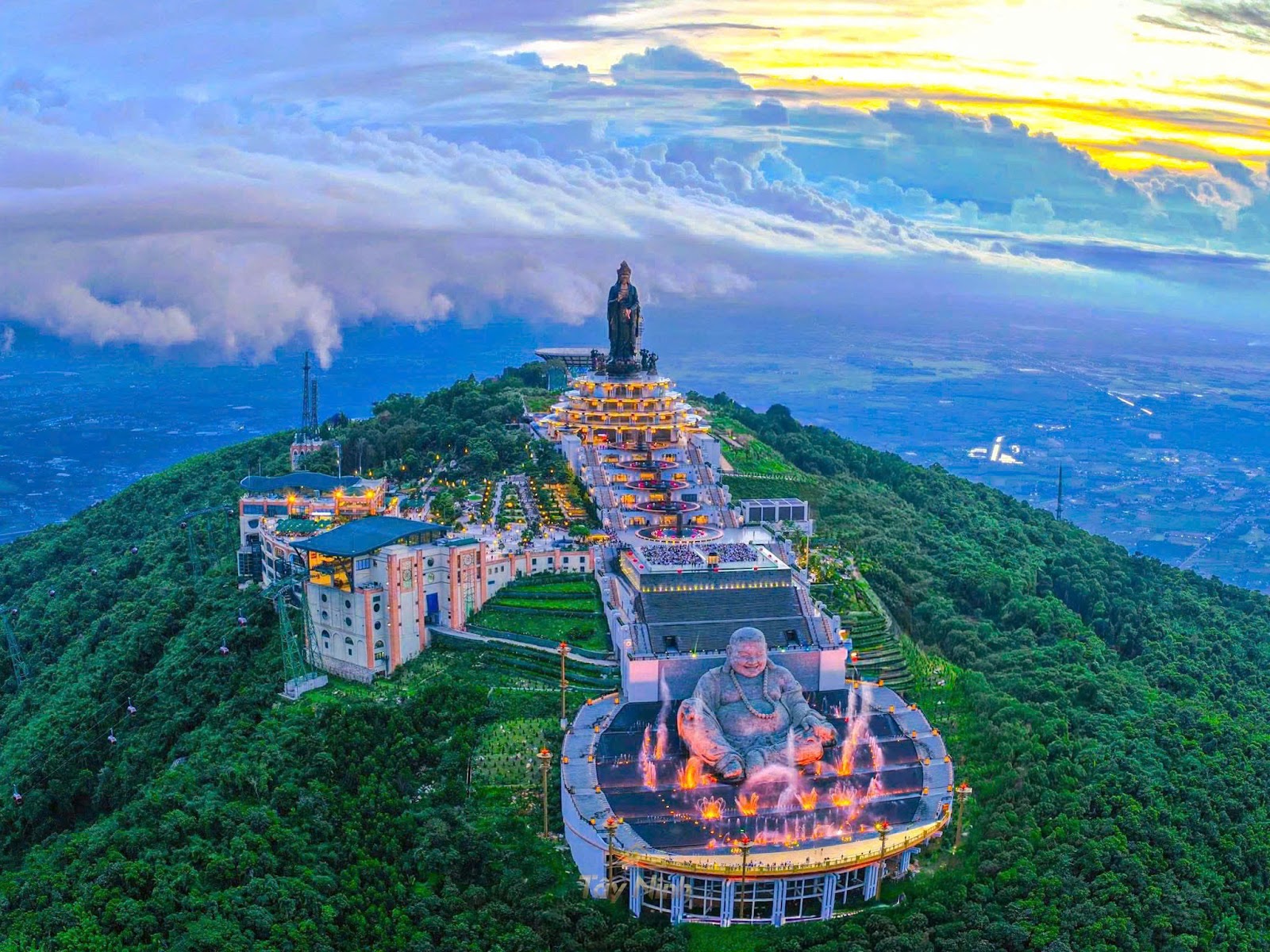
Together with the Tay Bo Da Son Bodhisattva Statue - representing the present and the Maitreya Bodhisattva Statue - representing the future, the Konagamana Buddha Statue, representing the past, forms a continuum linking past, present, and future upon the sacred mountain summit. Today, Ba Den Mountain has become a destination where Buddhists and visitors contemplate the self, release concerns about the past or future, live fully in the present moment with mindfulness, and seek true happiness.
Let's start your vacation!

Special offer up to 30% when booking tickets on the Sun Paradise Land app

