


Iconic landmark

Ba Na Hills Golden Bridge: An iconic landmark in global tourism
The Golden Bridge is located within the Sun World Ba Na Hills tourism complex, atop Mount Chua in the Ba Na area, approximately 25 km from downtown Da Nang. Situated at an elevation of more than 1,400 metres above sea level, the bridge is surrounded by mountainous forests and the distinctive mist that often envelops this region.
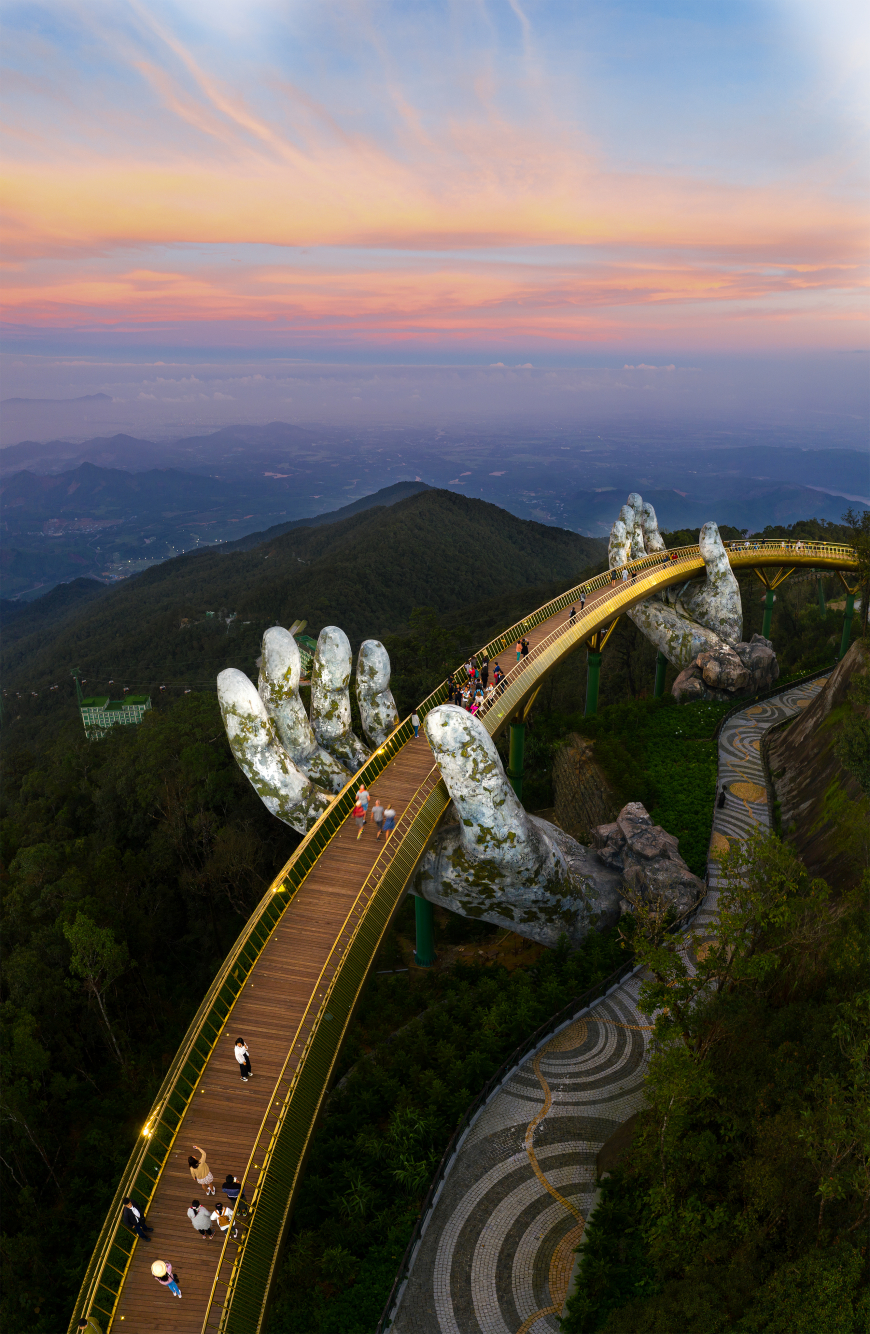
Unlike most tourist bridges, which span rivers or lakes, the Golden Bridge was designed as a pedestrian walkway extending along the mountainside.
What makes the structure special is not only its elevated location but also the sense of openness it creates. Standing on the bridge, visitors feel as though they are walking among the clouds, surrounded by mountain breezes and nature. This experience transforms the Golden Bridge from a mere architectural structure into an emotionally memorable stop on a journey to explore Ba Na.
Over the years, the Golden Bridge at Ba Na Hills has become one of the defining images of Da Nang tourism. Many visitors choose to travel to Ba Na not only to explore the tourism complex but also to experience firsthand what it feels like to walk across this world-famous bridge.
What quickly captured the attention of international media was the Golden Bridge’s distinctive design, with two giant hands appearing to support the bridge deck amid the mountainous landscape. This striking image creates an impression that is both tangible and surreal, setting the structure apart from conventional tourist bridges.

From the bridge, visitors can take in sweeping views of Ba Na’s mountain forests and, on clear days, see Da Nang in the distance.
The bridge deck resembles a graceful golden ribbon curving along the mountainside. In contrast, the giant hands feature a weathered, rough-hewn appearance, as though they were formed from natural mountain rock. The contrast between the bright golden walkway and the ancient-looking hands gives the entire structure remarkable visual depth.
Beyond its visual appeal, the Golden Bridge also carries a clear symbolic meaning. The concept of “the hands of the mountain god supporting a bridge in the sky” gives the structure a narrative dimension, making it more than just another tourist attraction. This distinctive concept has also helped the bridge gain widespread attention on social media and international travel platforms.
Soon after its unveiling, images of the Golden Bridge were featured by major media outlets, including CNN, BBC, The Guardian, and The New York Times, which highlighted it as an outstanding architectural landmark. Beyond generating international media attention, the bridge has helped reshape the way international visitors perceive Da Nang—from a familiar beach destination into a city home to globally recognised landmarks.
What makes the Golden Bridge at Ba Na Hills so distinctive is not only its unusual appearance but also the way it has been integrated into the natural landscape. Rather than creating a purely functional bridge, the design team took a more evocative approach, transforming the structure into an integral part of Ba Na’s mountainous surroundings.
The central concept draws on the image of “the hands of the mountain god” supporting a walkway suspended in mid-air. Looking out across the mist-covered mountains of Ba Na, the architects sought to create the impression that nature itself was supporting visitors, rather than having them simply cross a man-made structure.
Accordingly, the Golden Bridge was designed as a soft, ribbon-like walkway floating above the landscape, while the supporting hands were given an ancient, rugged appearance, with a weathered patina. Together, these elements create an atmosphere that feels both fantastical and closely connected to the surrounding mountains.
One notable feature is that the structure deliberately avoids an overly modern appearance. Instead, many details have been carefully treated to create an aged effect, as though the bridge had existed in the landscape for centuries. This approach gives the landmark greater visual and emotional depth than many conventional photo spots.
International articles about the Golden Bridge at Ba Na Hills frequently highlight its ability to combine iconic architecture with the natural environment. Rather than overwhelming the landscape, the structure appears to blend into the misty mountains, making the experience of standing on the bridge all the more extraordinary.
Although the Golden Bridge appears delicate and lightweight as it extends through the air, it is, in fact, a technically complex structure built on challenging high-altitude terrain. The bridge is approximately 150 metres long, with a series of connected spans following a gently winding curve along the mountainside.
The bridge deck is built using a steel framework combined with reinforced concrete to ensure load-bearing capacity and structural stability under Ba Na’s characteristic weather conditions. Its surface features a golden metallic finish, creating a striking visual effect when illuminated by sunlight or seen through a thin veil of mountain mist.
The railings on both sides are designed with a minimalist approach to preserve unobstructed views of the natural surroundings rather than making the space feel enclosed. This detail creates a much greater sense of openness while walking across the bridge, particularly when the skies are clear and visitors can see the mountains below.
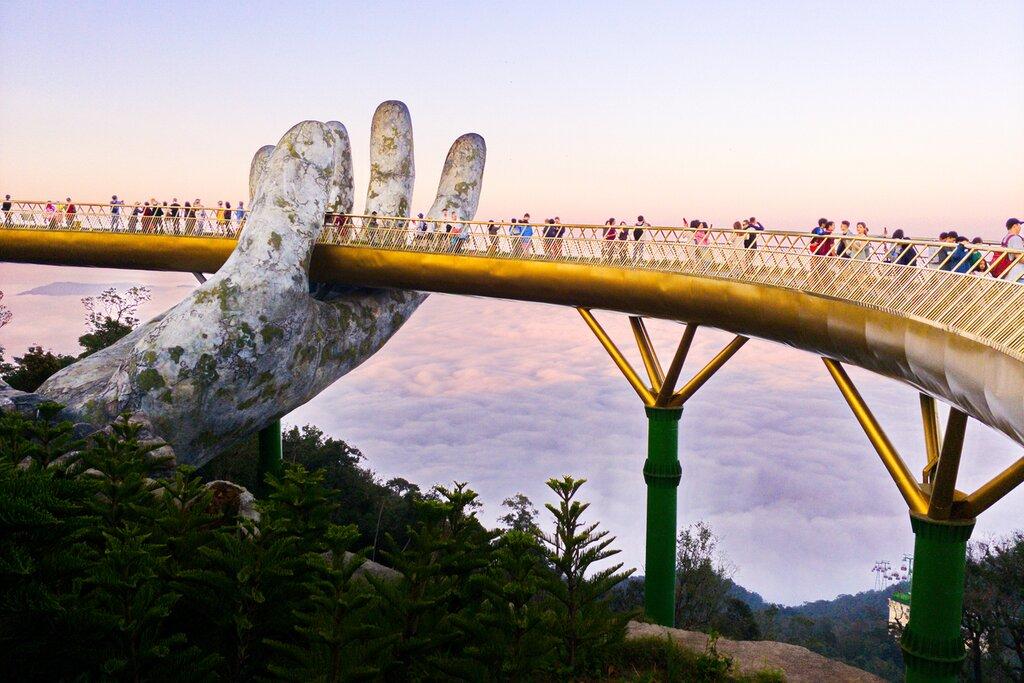
The most distinctive feature remains the giant hands supporting the bridge.
Although they resemble natural stone, their internal structures are actually made from steel frameworks and specialised sculpting materials. The exterior has been finished using theming techniques to create the appearance of ancient, moss-covered rock, giving the entire structure greater visual depth and a more natural look.
One of the greatest challenges was ensuring that the hands were imposing enough to make a visual impact without appearing too heavy or artificial. Their forms were therefore carefully refined in terms of proportions, colours, and surface textures, allowing the structure to remain harmonious with the surrounding landscape when viewed from a distance.
By combining modern construction techniques with a highly symbolic design concept, the Golden Bridge at Ba Na Hills has become more than a famous photo spot. It is also regarded as one of Vietnam’s most recognisable tourism landmarks in recent years.
Few people realise that behind the Golden Bridge’s graceful and dreamlike appearance lies a challenging construction process on Ba Na’s complex mountainous terrain. The project was completed within a relatively short period but had to overcome numerous harsh conditions characteristic of the area.
The greatest challenge was the construction site itself. The bridge was built along a steep mountainside, where transportation routes were limited and weather conditions changed constantly. Transporting materials, equipment, and workers to an elevation of more than 1,400 metres required meticulous planning and coordination to maintain the construction schedule while ensuring safety.
Ba Na’s weather also placed considerable pressure on the construction team. Dense fog, high humidity, and sudden rainfall meant that many construction activities had to be adjusted repeatedly. At times, reduced visibility on the mountain affected structural positioning and installation. During certain phases, the team had to take advantage of brief windows of favourable weather to accelerate progress.
The giant supporting hands were the most complex part of the project, as they had to meet structural requirements while achieving a natural appearance resembling real mountain rock. The construction team had to work not only on the load-bearing structures inside the hands but also on the exterior finish, creating an ancient, moss-covered look with a rough texture similar to natural stone.
Remarkably, despite the project’s scale and difficult-to-access location, the bridge was completed in a relatively short time. This demonstrates the high level of coordination required among the design team, engineers, and construction crews throughout the project.
After its completion, the Golden Bridge at Ba Na Hills quickly attracted widespread attention, not only for its distinctive design but also for the way it sits within the high-altitude natural landscape. This integration often gives visitors the impression that the bridge truly belongs to its surroundings, rather than appearing as a structure detached from the environment.
The most distinctive aspect of visiting the Golden Bridge at Ba Na Hills is its remarkable sense of openness. Unlike many crowded urban photo spots, the bridge offers the feeling of walking among clouds, mountain breezes, and forests at an elevation of more than 1,400 metres.
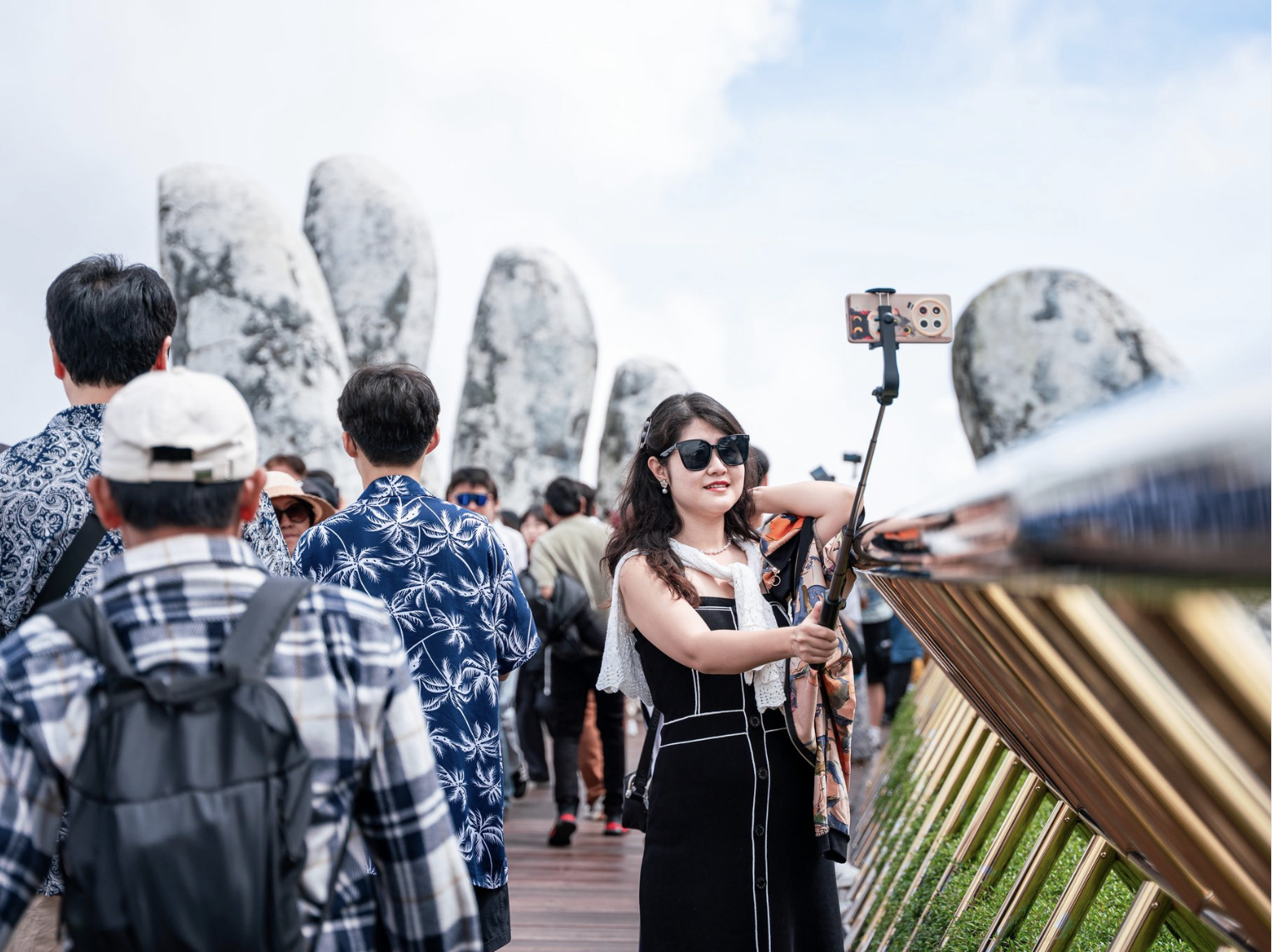
In the morning, a thin layer of mist often gathers around the bridge, lending the entire landscape a softer appearance and greater visual depth.
As sunlight begins to filter through the clouds, the golden bridge deck stands out against the sky and the green mountains, creating a striking visual effect. Many visitors also remark on how quickly the weather can change while they are on the bridge. At one moment, the sky may be clear, revealing panoramic views of the mountains and the distant city. Just a few minutes later, clouds may envelop the entire area, making the bridge appear to float in mid-air.
These constantly changing conditions mean that no two visits to the Golden Bridge are exactly alike. Even from the same vantage point, variations in light, clouds, and atmosphere can create entirely different experiences.
It did not take long for the Golden Bridge at Ba Na Hills to become one of Vietnam’s most famous photo spots. Its giant supporting hands create a highly recognisable image that immediately brings Da Nang and Ba Na to mind.
One of the bridge’s greatest strengths is that almost every angle offers the potential for a beautiful photograph. Wide-angle shots capture the bridge curving through the mountains, while close-up compositions highlight the weathered, moss-covered hands. Both perspectives create a strong visual impact.
Morning is often the preferred time for photography, thanks to its softer light and clearer atmosphere. In contrast, the afternoon offers a different mood, as golden sunlight bathes the entire structure, creating a warmer and more romantic atmosphere.
Beyond photography, many visitors choose to spend time standing on the bridge to admire the scenery and take in the mountain air rather than simply walking across it. This is another feature that distinguishes the Golden Bridge from conventional photo spots: the experience is not just about capturing an image, but also about feeling immersed in the open sky and misty mountains of Ba Na.
More than an outstanding architectural landmark, the Golden Bridge at Ba Na Hills has become a new symbol of Da Nang tourism through its combination of creative design, natural scenery, and an emotionally engaging visitor experience. From the giant hands rising among the misty mountains to the sensation of walking high above the ground atop Mount Chua, every detail contributes to the bridge’s distinctive identity.
Let's start your vacation!

Special offer up to 30% when booking tickets on the Sun Paradise Land app

