


Cuisine

Discover Nhoi Mountain in Thanh Hoa with a "museum" of ancient stones in the Thanh Hoa region.
Like a gift that nature has kindly bestowed upon Thanh Hoa province, Nui Nhoi (also known as Nui An Hoach) is located in Hac Thanh ward. This place is likened to a "treasure in the heart of Thanh Hoa". This mountain is also called by many other names by the locals such as Nui Khe, Nhue Son, or An Hoach Son according to ancient Sino-Vietnamese.
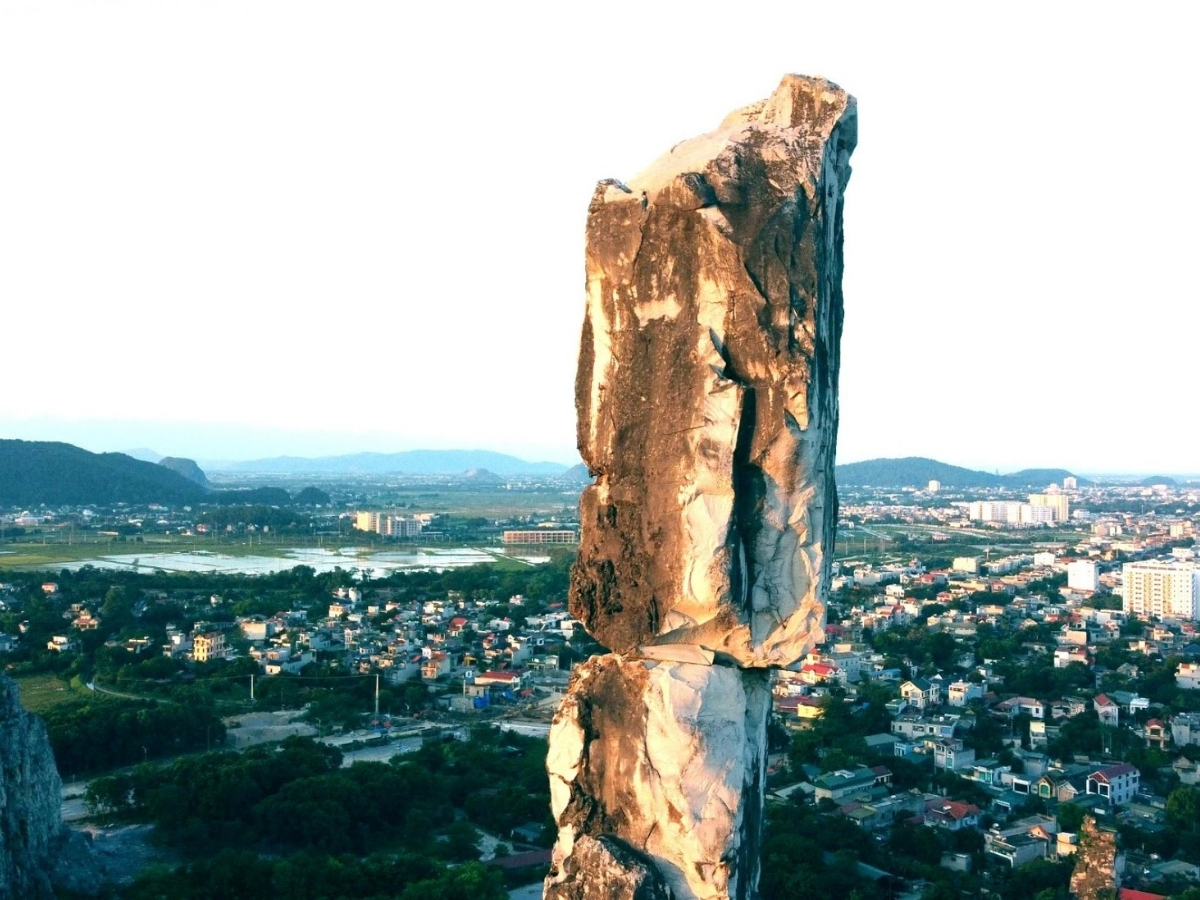
Nui Nhoi is located in Hac Thanh ward, Thanh Hoa. (Source: Collected)
Nui Nhoi is over 100 m high, its shape undulates like a giant elephant kneeling beside a lush green field. Just about 3 km west of Thanh Hoa city center, this place is a convenient stop for those who want to explore the unique culture and history of the Thanh Hoa land.
Since 1992, Nui Nhoi has been recognized by the Ministry of Culture and Information (now the Ministry of Culture, Sports and Tourism) as a national-level artistic scenic relic. Not only possessing unique natural beauty, this place is also the cradle of the renowned traditional stone carving craft, famous for its smooth, pliable, and iridescent stone, like jade.
According to ancient historical records, the stone of Nui Nhoi is praised as the rarest precious stone: “The stone's color is iridescent like jade, its texture is bluish-green like faint smoke; when carved into chimes, the sound echoes for miles; when inscribed on steles, the literature endures for millennia.” Thanks to this precious stone resource, along with the skillful hands and creative minds of the artisans, our ancestors left future generations a complex of relics and a unique cultural space, rich in artistic value.
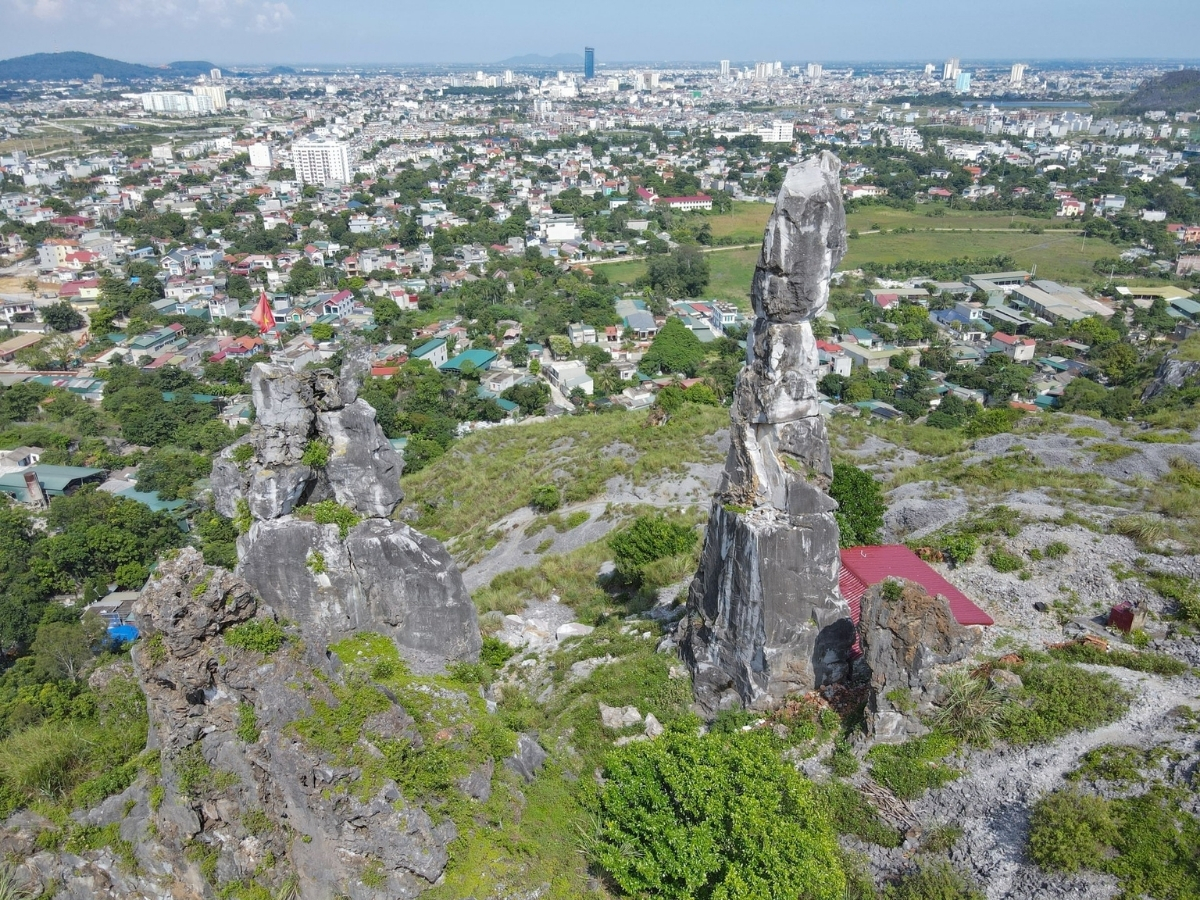
Panoramic view of Nui Nhoi from above. (Source: Collected)
Bao quanh Nui Nhoi là hệ thống núi liên hoàn gồm Nui Dong ở phía tây, Nui Chan Than ở phía tây nam, Nui Nap (Quang Nap) ở phía nam và Nui Chong Mam (hay Nui Dinh Thuong) ở phía bắc. Dưới chân núi là dòng Huong Giang hiền hòa uốn lượn quanh làng xóm, rồi hòa vào Song Ma tạo nên cảnh sắc thiên nhiên hùng vĩ và hữu tình.
Xưa kia, dưới chân Nui Dong, từng diễn ra khung cảnh nhộn nhịp “trên bến dưới thuyền”, nơi buôn bán sầm uất các sản phẩm chế tác từ đá Nui Nhoi. Đá Nhồi theo dòng thương nhân đã có mặt khắp nơi trong nước, góp phần xây dựng nên những lăng tẩm, bia ký, tượng đá và công trình kiến trúc nổi tiếng. Sắc đá óng ánh, tiếng đá ngân trong khiến tên tuổi nghề đục đá làng Nhồi vang xa, thậm chí được người xưa truyền tụng rằng “khánh đá Nhồi ngân vang tận Trung Hoa”.
Ngày nay, Nui Nhoi không chỉ là di tích lịch sử - văn hóa cấp quốc gia, mà còn là biểu tượng nghệ thuật và niềm tự hào của người dân xứ Thanh, nơi giao thoa giữa thiên nhiên kỳ vĩ và tinh hoa lao động của con người Việt Nam.
Hành trình di chuyển đến Nui Nhoi Thanh Hoa hiện nay rất thuận tiện. Từ trung tâm Thanh Hoa, du khách xuất phát theo đại lộ Le Loi hướng về phường An Hung. Quãng đường dài chỉ khoảng 3 km, di chuyển bằng ô tô hoặc xe máy mất chưa đầy 10 phút. Tuyến đường được quy hoạch khang trang, giao thông thông thoáng quanh năm, phù hợp cho cả những chuyến đi ngắn trong ngày.
Nếu muốn thoải mái hơn, du khách có thể đặt taxi hoặc sử dụng các ứng dụng gọi xe công nghệ, đặc biệt tiện lợi cho nhóm bạn hoặc gia đình nhỏ muốn tận hưởng hành trình mà không cần lo lắng về việc tìm đường hay đỗ xe.
Đối với du khách khởi hành từ Ha Noi, có thể lựa chọn đi theo cao tốc Ha Noi - Ninh Binh - Thanh Hoa (CT01). Quãng đường khoảng 150 km, thời gian di chuyển khoảng 2,5-3 giờ. Từ trung tâm Thanh Hoa, tiếp tục đi theo đại lộ Le Loi để đến Nui Nhoi, tuyến đường ngắn gọn, dễ tìm và có biển chỉ dẫn rõ ràng.
Nui Nhoi Thanh Hoa là điểm đến có thể ghé thăm quanh năm, mỗi mùa lại mang một sắc thái và trải nghiệm riêng biệt.
Vào mùa xuân, từ tháng 2 đến tháng 4, sắc xuân lan tỏa khắp không gian, Nui Nhoi khoác lên mình vẻ trong trẻo và tràn đầy sức sống. Không khí mát lành, cây cối đâm chồi nảy lộc khiến khung cảnh thêm thi vị. Đây cũng là thời điểm lý tưởng để du khách vừa ngắm cảnh, vừa hòa mình vào không khí lễ chùa đầu năm tại các ngôi chùa quanh núi như chùa Tien Son, cảm nhận sự thanh tịnh và linh thiêng của vùng đất từng được mệnh danh là “kinh đô đá” xứ Thanh.
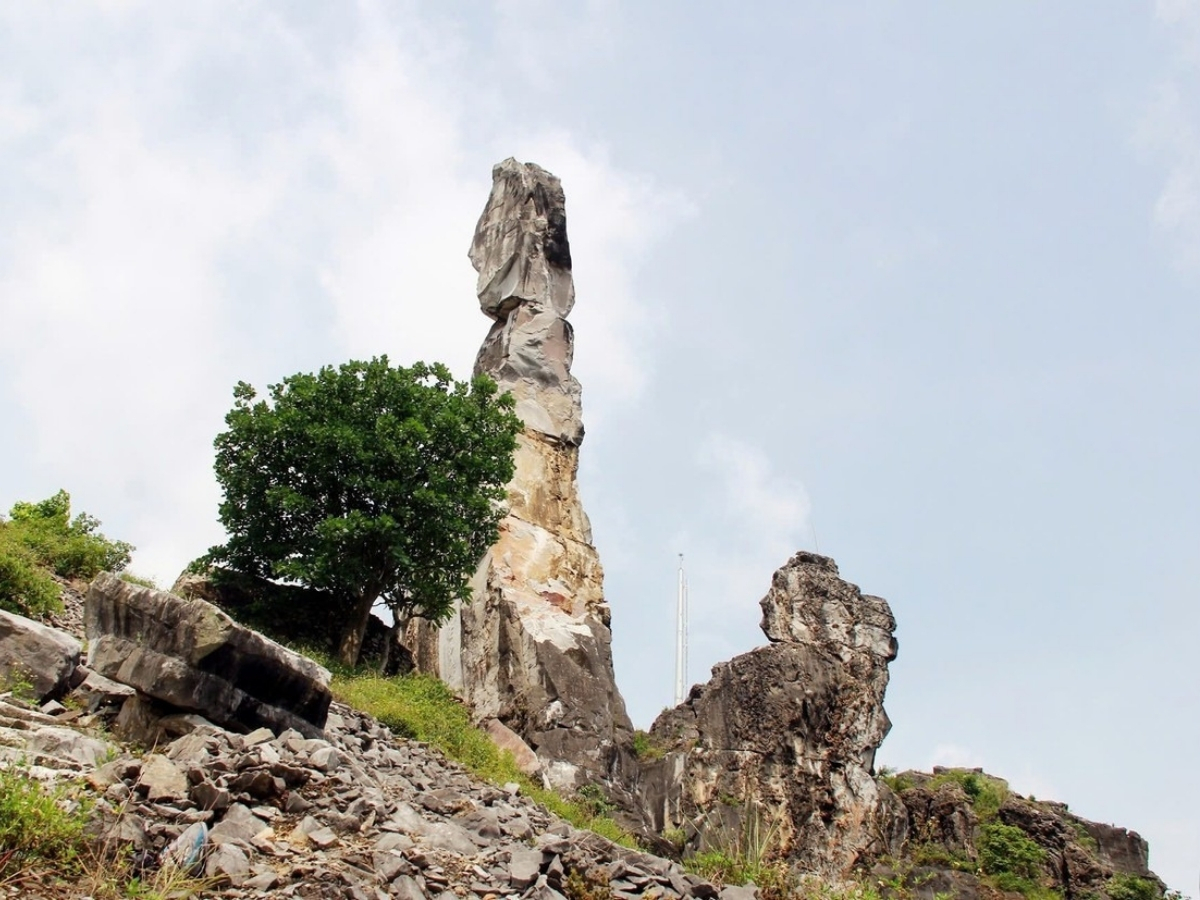
Nhoi Mountain is suitable for visiting year-round. (Source: Collected)
When autumn arrives, from September to November, the weather is dry, and gentle sunlight stretches over the ancient rocks, making this place an ideal stop for photography and mountain climbing enthusiasts. Regardless of the season, Nhoi Mountain offers visitors unique experiences. Each trip is an opportunity to discover a new perspective on the long-standing cultural and artistic heritage, while also deeply feeling the essence of the land and people of Thanh Hoa province.
Within the scenic complex of Nhoi Mountain, Vong Phu Stone is the symbolic highlight, associated with the legend of a loyal wife waiting for her husband. On the summit of Nhoi Mountain, a large rock stands out, about 20m high, shaped like a mother holding a child, gazing towards the East Sea. Since ancient times, people have called this place Vong Phu Mountain, which is also another name for Nhoi Mountain.
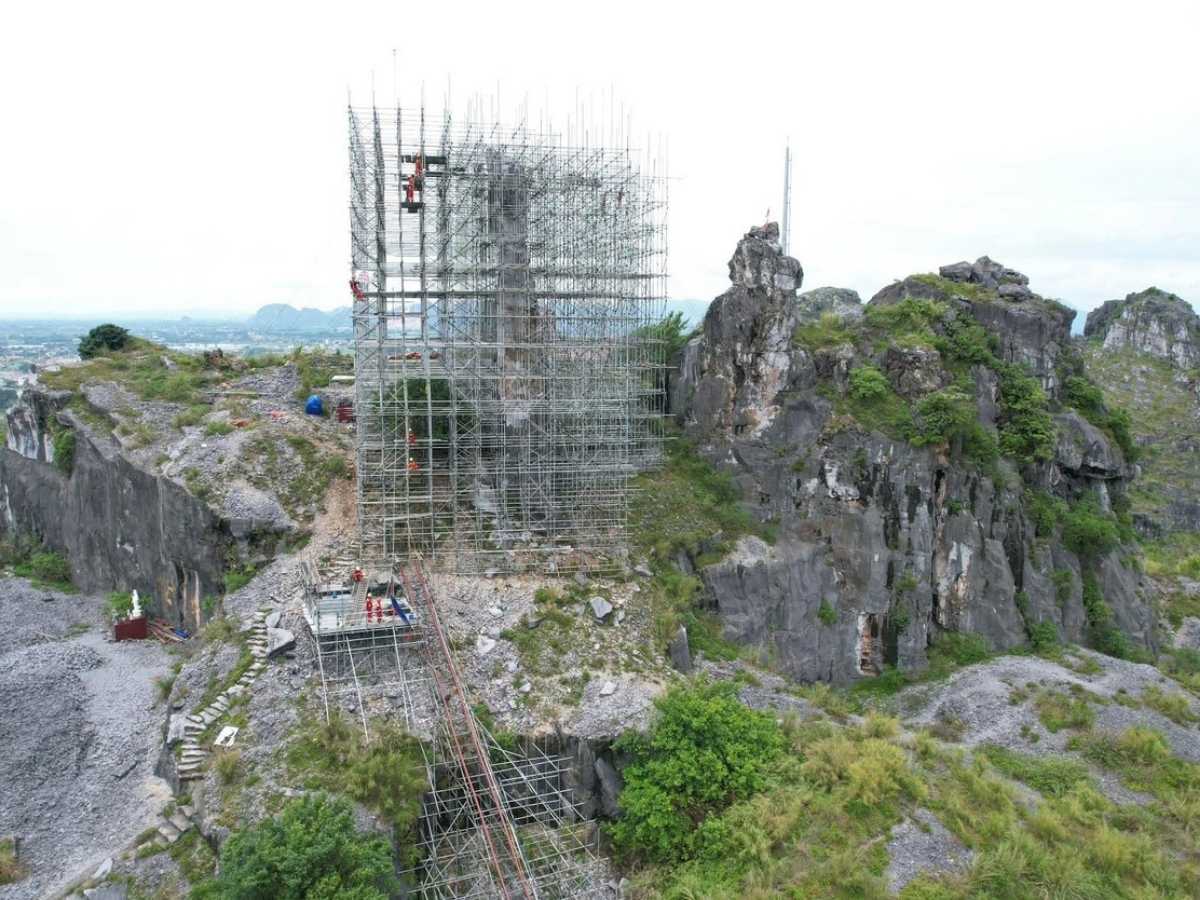
Currently, Vong Phu stone is being invested in for renovation. (Source: Collected)
Legend has it, when the sea still encroached upon the mainland, people lived by fishing. A young wife, day after day, carried her child to the top of Nui Nhoi mountain to light a fire, hoping her husband, fishing offshore, would return soon. However, a fierce storm swept his boat away, and he never returned. Her longing turned into an endless wait, and the wife, with her young child, stood by the mountainside until they turned to stone.
Today, visitors to Nui Nhoi mountain can stop at the foot of the Vong Phu stone to admire the masterpiece of nature and capture memorable moments amidst the majestic and sacred space of the ancient mountain.
Located at the foot of Nui Nhoi mountain, Thuong Temple (also known as Bon Ban Temple) is the cultural center of four ancient villages: Nhue, Tu, Nay, and Sau. Here, the Village Guardian Deity - the ancestor of stone carving craft, and Duke Le Trung Nghia, a talented general of the Le dynasty who made great contributions to his homeland.
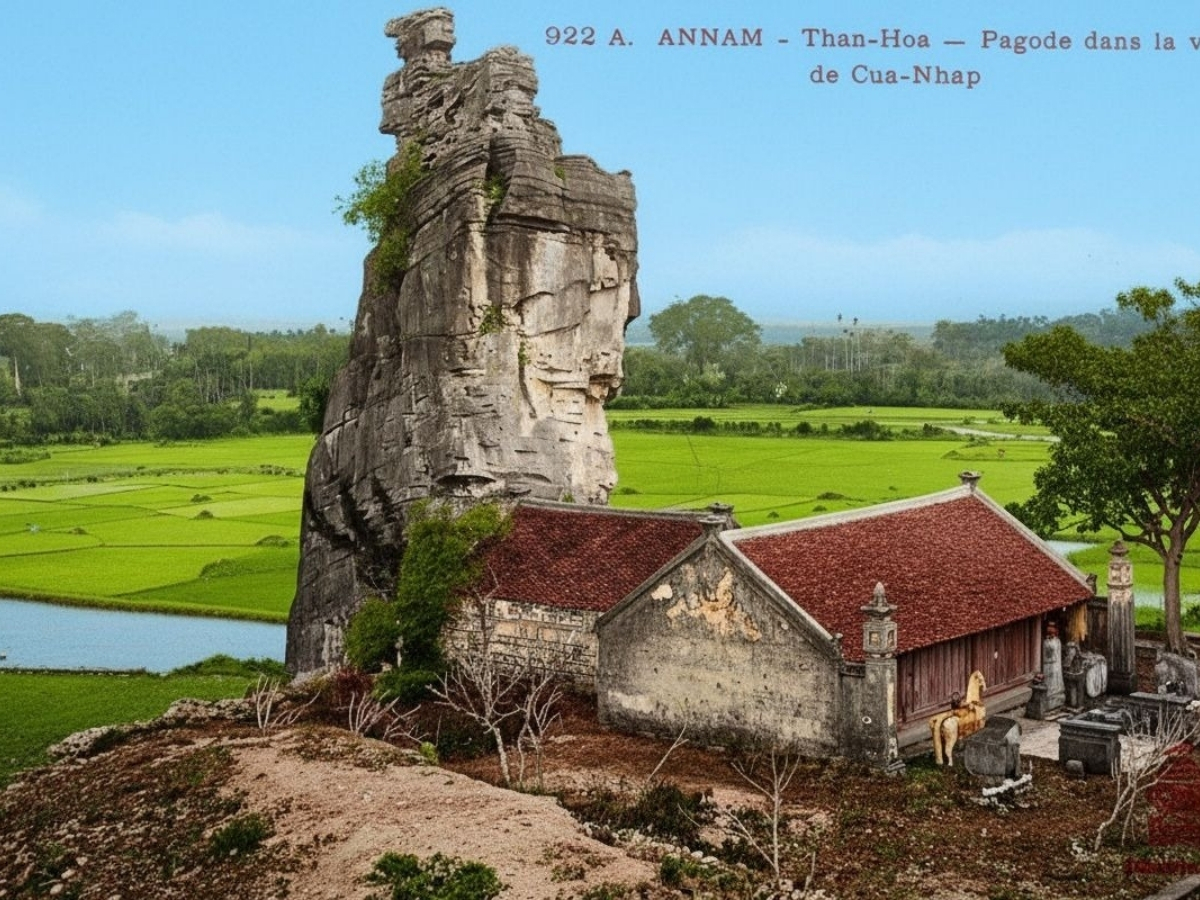
Photo of Dinh Thuong on Nui Nhoi taken by the French in 1910. (Source: Collection)
According to historical records, Dinh Thuong was once a large-scale stone structure, built by the talented hands of artisans from Nhoi village. Over time, many sections have faded, but this place still preserves elephant statues, horse statues, warriors, stone figures, incense altars… bearing the distinct sculptural style of the 17th - 18th centuries.
The stone works at Dinh Thuong not only possess aesthetic value but also demonstrate the exquisite carving skills of ancient Vietnamese artisans. Therefore, this place is likened to an "open-air stone art museum", preserving the soul of the traditional craft that has brought glory to the Thanh region for generations.
Part of the Nui An Hoach relic complex, the tomb and temple of Man Quan Cong Le Trung Nghia is a unique stone architectural work built in the 18th century. Quan Cong Le Trung Nghia (surname Nguyen, from An Hoach commune) was an official who made significant contributions to the Le Trung Hung dynasty. Due to his great merits, he was revered by the villagers as Hau Than, with a "sinh tu" (living temple) established while he was alive and worshipped through many generations.
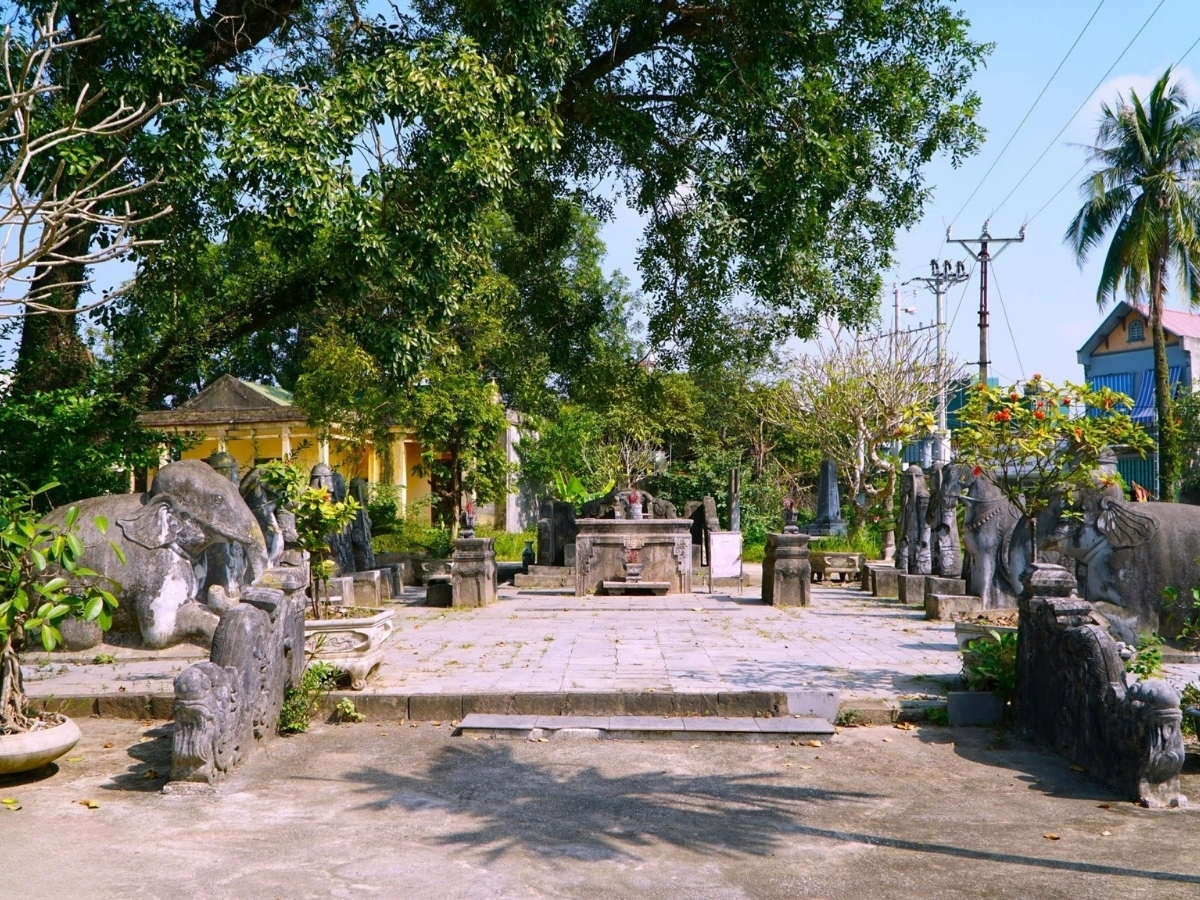
The space of the tomb of Earl Man Le Trung Nghia. (Source: Collected)
The tomb of Earl Man is constructed entirely from Nui Nhoi mountain stone. This is a fine white, deep blue stone with a clear resonance. The complex includes a worship hall, warrior statues, kneeling elephants, attendant horses, stone dragons, inscriptions, and incense altars, all exquisitely carved according to strict feng shui principles. Despite having existed for over two centuries, the tomb retains its complete layout and high artistic value, being recognized by researchers as one of Vietnam's masterpieces of 18th-century stone carving.
Visiting the tomb of Earl Man today, visitors can not only admire the ancient architectural beauty but also feel the spirit of gratitude towards ancestors, who contributed to glorifying the traditional stone craft of their homeland.
Nestled on the eastern cliff of Nui Nhoi mountain, Quan Thanh Pagoda, also known as Tien Son Tu, is one of the most unique Buddhist structures in the Thanh Hoa region. The pagoda was built during the Le Trung Hung period, located within a natural cave, exuding an ancient and mystical beauty.
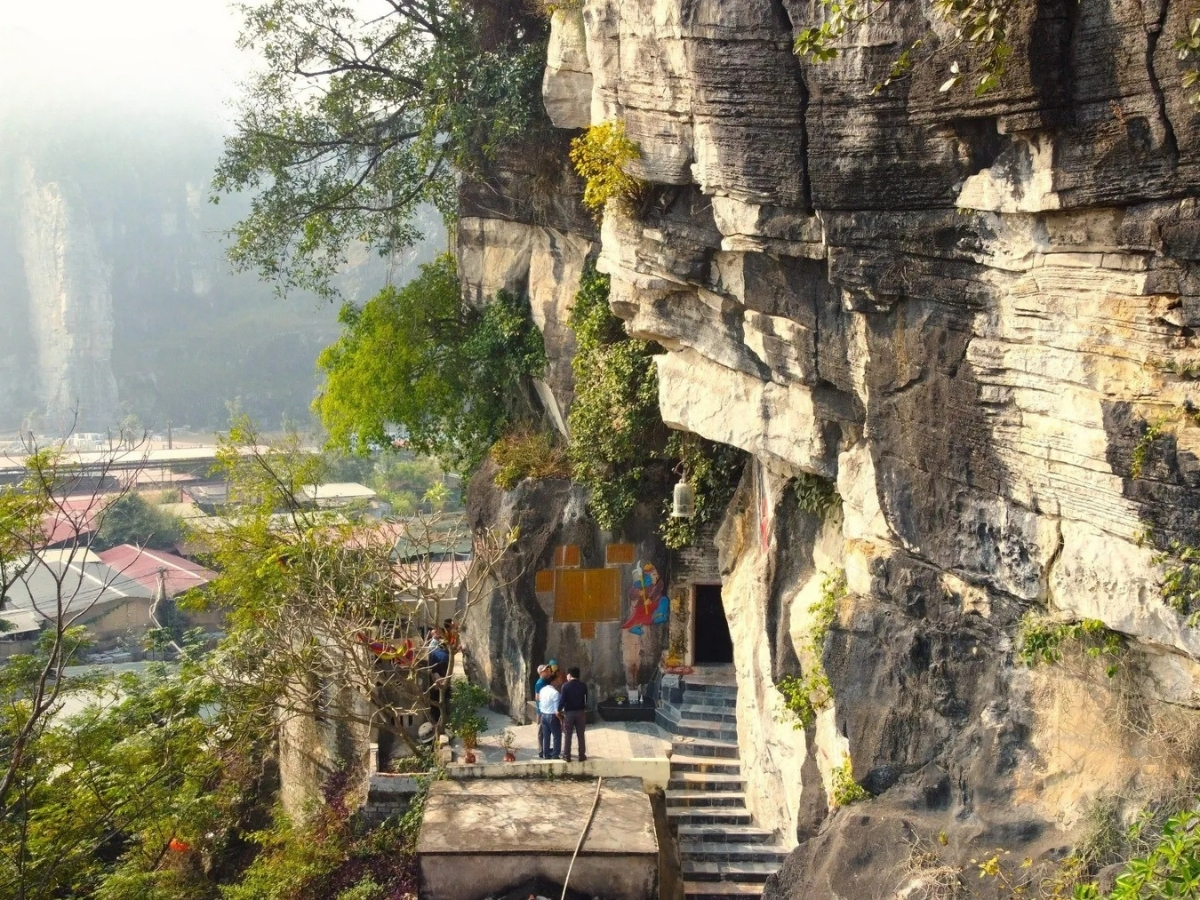
Quan Thanh Pagoda is located on the mountainside. (Source: Collected)
Stepping through the temple gate, visitors can admire a series of exquisitely carved bas-reliefs and stone statues right on the mountainside: human figures, elephants, horses, dragons, along with many ancient Chinese characters deeply carved into the stone. Inside the pagoda, there are still preserved statues of Quan De, Chu Xuong, and many stone mythical creatures, showcasing the master carving skills of artisans from Nho Lang.
The pagoda's atmosphere is tranquil, the mountain wind blends with the ringing of bells, creating a sense of peace and serenity. From the pagoda's vantage point, visitors can cast their eyes over the panoramic view of Nui Nhoi and the Thanh Hoa plains, a rare experience that is both sacred and picturesque.
To make the exploration of Nui Nhoi complete and safe, visitors should note the following points during their journey:
Choose neat, comfortable clothing, prioritizing light and breathable materials for convenience when climbing mountains and moving between relic clusters. Combine with soft-soled sports shoes to make walking on natural rocky terrain easier and safer.
Bring drinking water, sun hats, and sunscreen, especially in summer, as the mountain area has little shade.
Maintain the sanctity at spiritual relic sites, speak softly, avoid making noise, and absolutely do not write, carve, or draw on the surfaces of ancient stones and statues.
Take time to rest at points with high vantage points, enjoy the fresh air, and admire the panoramic view of the Thanh Hoa plains from the mountain.
After visiting and exploring the unique cultural space of Nui Nhoi, visitors can continue their journey to Sam Son Beach. As one of the most famous beaches in the North, Sam Son boasts a long sandy shore, clear blue waters, and a developed tourism service system, offering a complete resort experience.
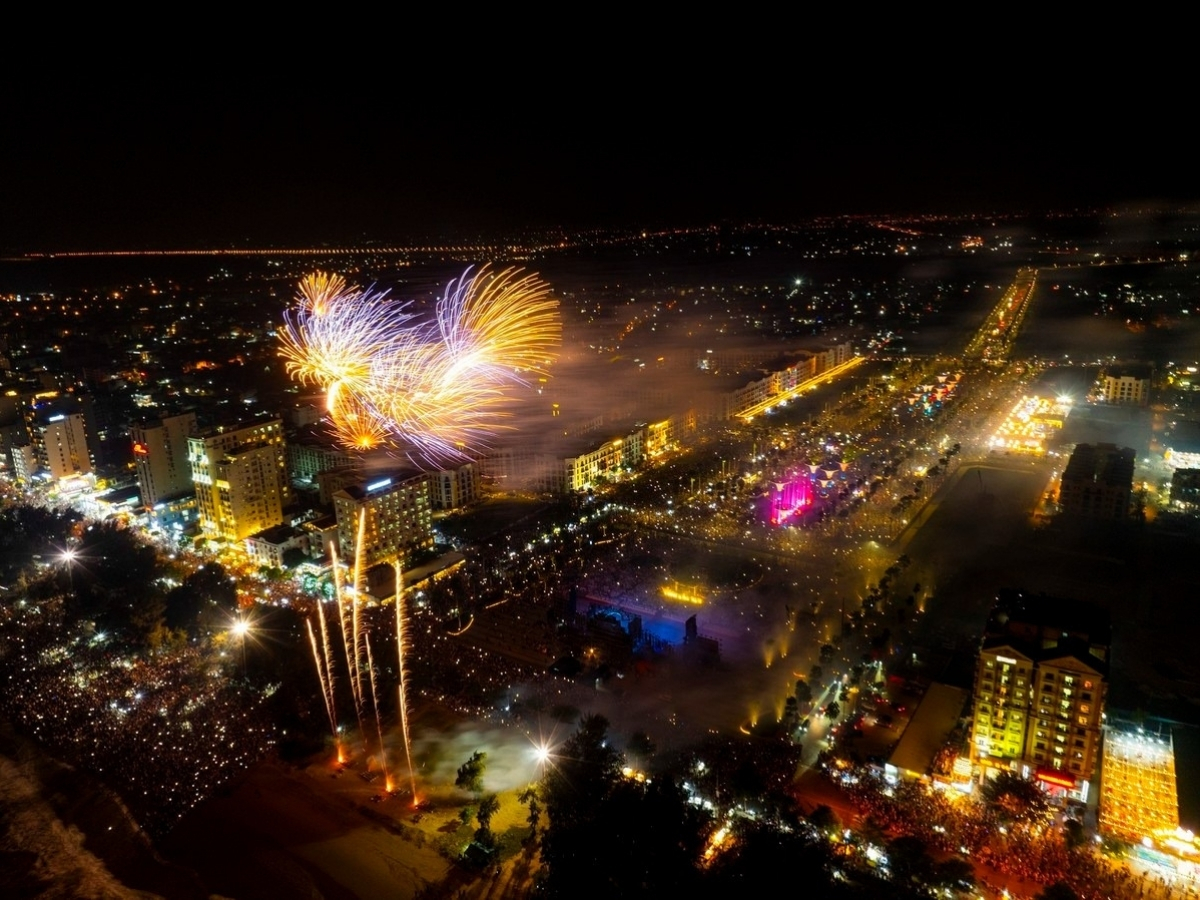
The Beach Square is a must-try destination when visiting Sam Son. (Source: Collected)
The modern highlight of the area is the Sam Son Beach Square. This is where light festivals, cultural events, and large-scale art performances are frequently held. In the evening, the brilliant lights create a sparkling scene, making it an ideal check-in spot for all tourists. Coming to Sam Son, you can stroll along the sandy shore, enjoy fresh seafood, or experience high-class resort services at the coastal resorts.
Located in Nga Son commune, Mai An Tiêm Temple is a spiritual destination associated with the legendary story of the originator of the watermelon variety in Vietnam. According to legend, Mai An Tiêm was exiled to a deserted island, but thanks to his will and determination, he planted watermelon seeds, bringing a valuable food source and becoming a symbol of the spirit of labor and self-reliance of Vietnamese people.
The temple complex is located in a peaceful space, with mountains behind and the gentle Hoat River in front, creating a feng shui position of "sitting on a mountain, facing the water". The temple's architecture bears a strong traditional style, has been renovated to be spacious and magnificent, but still retains its ancient charm. Annually, in the 3rd lunar month, the Mai An Tiêm festival is solemnly organized with many folk activities such as palanquin processions, cake wrapping contests, fruit tray displays, recreating the spirit of overcoming difficulties and gratitude to ancestors.
Combining a trip to Nui Nhoi mountain and Mai An Tiêm Temple, visitors will have the opportunity to look back at the historical and cultural journey of the people of Thanh Hoa region, a place that converges both heroic spirit and creative resilience from ancient times.
Located in the Thanh Hoa center, Ham Rong historical site is a landmark of special value in national history. This place includes Ham Rong Bridge, Ham Rong Mountain, and a memorial complex for heroes and martyrs, associated with glorious victories in the resistance war against the US for national salvation.
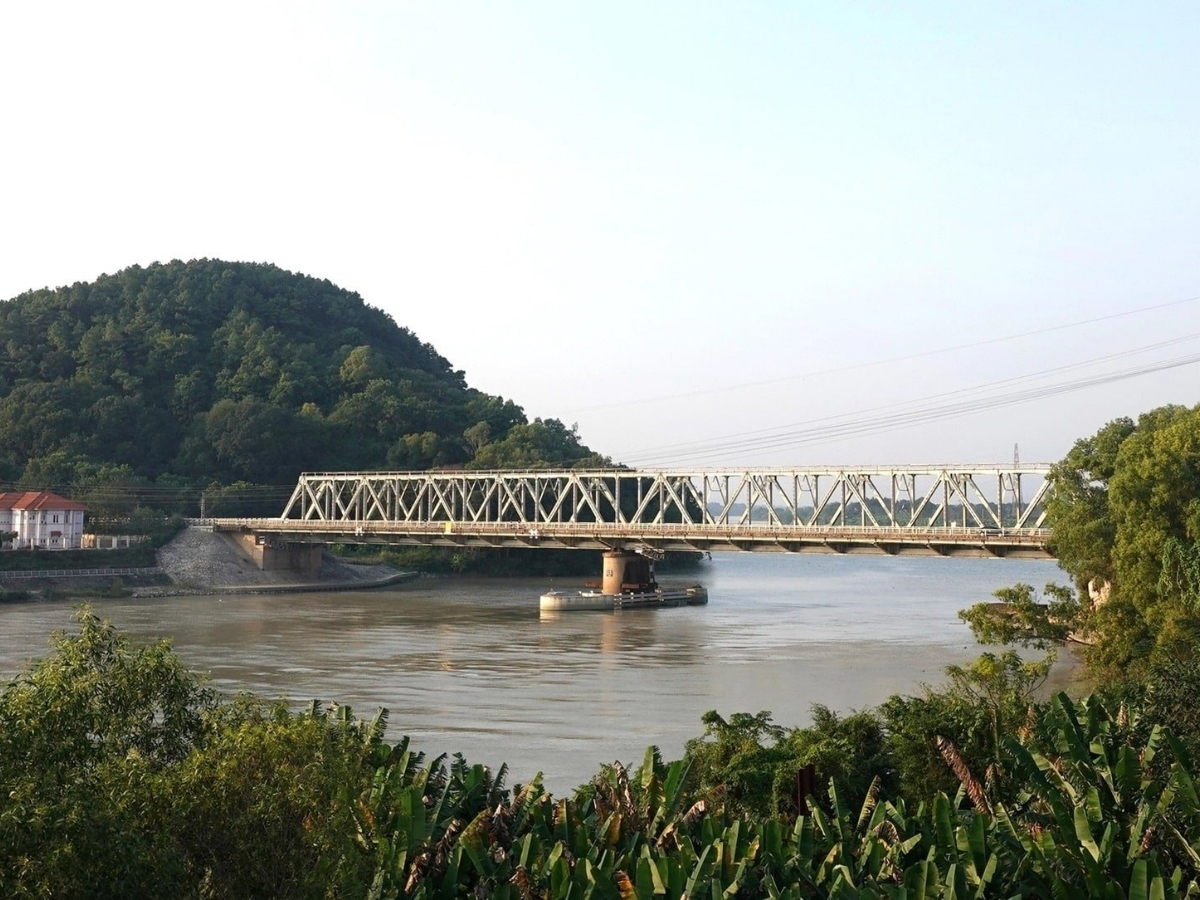
Ham Rong Bridge is a historical witness in the resistance war against the US. (Source: Collected)
During the two resistance wars, Ham Rong Bridge was a vital point on the North-South transportation route, enduring hundreds of bombing raids but still standing firm resiliently. Today, visitors to Ham Rong can visit the Ham Rong Museum, learn about historical battles, while admiring the panoramic view of the Ma River winding through majestic mountains and rivers.
Ham Rong is an indispensable stop for tourists who want to understand more deeply about the heroic land of Thanh Hoa.
Nui Nhoi Thanh Hoa is not just a tourist attraction but also a journey to discover the thousand-year cultural heritage of Thanh Hoa. It blends natural beauty with the essence of traditional stone carving art. Plan a visit to experience a unique ancient stone "museum" in the heart of Thanh Hoa!
Let's start your vacation!

Special offer up to 30% when booking tickets on the Sun Paradise Land app

